Carpet vs Super Built-up - A Buyer Education Note
Under the Real Estate (Regulation and Development) Act, 2016, all sale agreements must reference carpet area - the net usable internal space of the apartment, excluding shared common areas. Super built-up area (sometimes called sellable area) includes a proportional share of common amenities - lift cores, corridors, lobby, clubhouse, and other built infrastructure.
For Purva Heritage, the published unit sizes (1,300 sqft for 2 BHK, 1,900 sqft for 3 BHK) are the carpet figures used for pricing. The super built-up area, which appears on the formal price sheet and the eventual sale agreement, will be in the range of 1.30–1.40× the carpet figure depending on the building's final common-area calculation. The per-sqft pre-launch price of ₹16,000 is applied to the carpet figure. For investment-thesis modelling, comparison shopping, and total cost calculation, work with the carpet figure - it is the only metric directly tied to project pricing and the only metric backed by RERA enforceability.
Floor Plate Strategy - 8 Units Per Floor, Central Core
The eight-units-per-floor central-core configuration is the floor plate's most consequential design decision. By placing four units on each side of a central service core (lift, staircase, electrical, plumbing risers), the design ensures that every apartment faces an external side rather than into another building wall. This delivers four practical outcomes: daylight on at least one major elevation per unit, cross-ventilation potential through windows or balconies on multiple sides, acoustic privacy by minimising back-to-back wall configurations, and shorter corridor walks from the lobby to every door.
The four-lift count for a 145-unit, 20-floor tower is a deliberately high ratio. Peak-morning lift wait times will be materially shorter than the Bengaluru high-rise norm, which typically runs at two lifts per 80–100 units. For families with school runs, working professionals on cab schedules, and senior residents who depend on lift reliability, this density of vertical transport is a meaningful daily-life upgrade over typical 145-home towers.
Floor Plan Selection - How To Think About It
For pre-launch buyers entering at the EOI stage, three considerations matter when choosing a floor-plate position:
- Aspect and view direction. West- and north-facing units typically command a small premium for evening sunlight and lower afternoon heat load. East-facing units get morning sun and are preferred by some buyer segments.
- Vertical position. Lower floors (3–8) are easier for older buyers and families with young children - faster lift access, easier evacuation, closer connection to the ground plane. Upper floors (15–20) command premium pricing for views and a sense of distance from street noise.
- Corner vs middle plate. Corner units within the 8-unit floor plate get dual aspect - windows on two external sides - and are typically priced at a small premium.
A practical selection method between the two configurations:
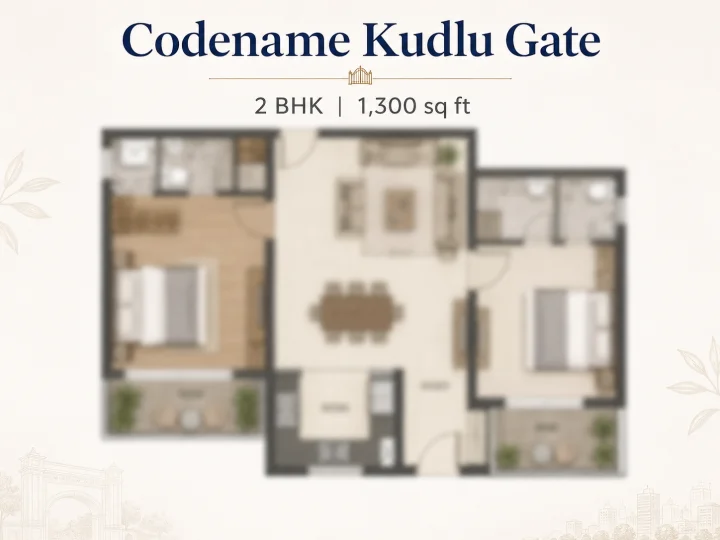
- Choose 2 BHK (1,300 sqft) if you are a couple or single professional, want the highest-yield format in the project, or are building a long-term rental portfolio. The wider living-dining and two balconies set this 2 BHK apart from the compact-2 BHK norm.
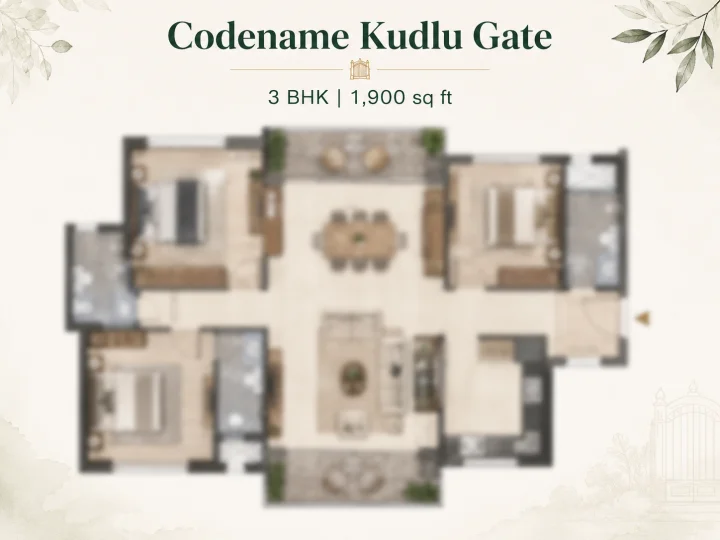
- Choose 3 BHK (1,900 sqft) if you are a growing family, value the bathtub primary en-suite, host frequently, plan multi-generational living, or want long-term residence rather than yield optimisation.
Before finalising, request the latest stamped floor-plan set, carpet area statement, and a full cost sheet aligned to your shortlisted stack and facing. That single step prevents most post-booking confusion around expectations, dimensions, and payment staging. Floor-plate availability, exact corner positions, and aspect angles will be shared by the relationship manager at the EOI stage and finalised at sale agreement.
It is also useful to test your shortlisted plan against real furniture and usage scenarios. Mark dining size, work-from-home desk zones, children's study flexibility, and wardrobe depth assumptions before booking. For the 2 BHK, the larger primary bedroom can comfortably absorb a king-size bed with a small work setup and a reading chair, while the wider living-dining can host 6-person dining without crowding the seating area. For the 3 BHK, the living-dining can comfortably host 8-person dining with a 3-seat sofa configuration, and the two balconies can support indoor plants, evening seating, or a small outdoor dining setup.
Floor plan visuals shown here are reference assets. Final dimensions and area statements should be confirmed from latest developer-issued documents at booking time.
Need a side-by-side comparison of the 2 BHK and 3 BHK with budget impact and family-fit guidance?
Request Plan Comparison